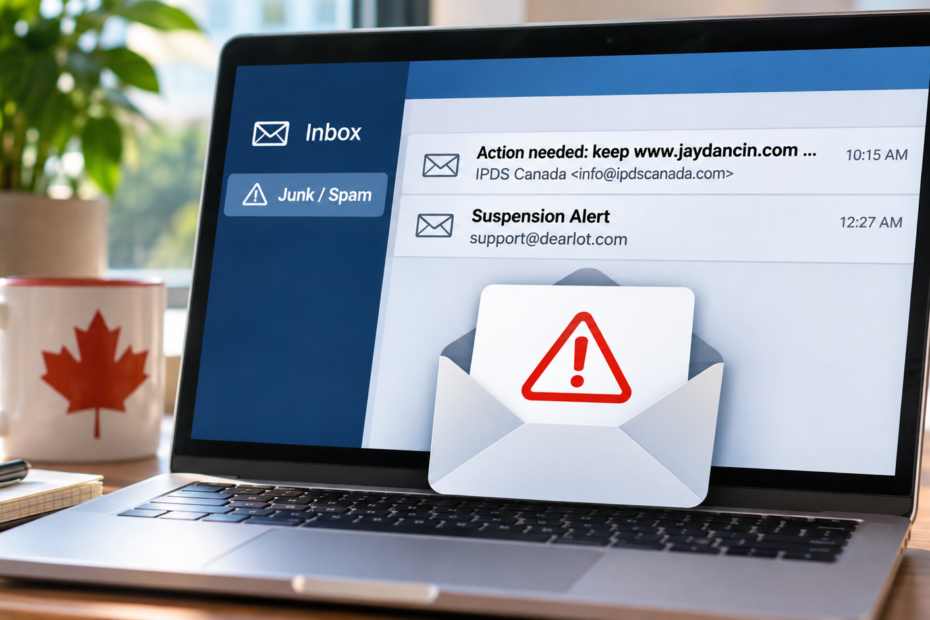
We’ve recently seen an increase in suspicious domain-related invoices and renewal notices being sent to website owners. In fact, Advantage Hosting customers brought two different examples to our attention in a single day.
Both messages appeared to demand payment for domain-related services. Neither sender was responsible for managing the recipient’s domain registration.
These messages are designed to look important, sometimes even urgent. They may mention your actual domain name, business name, address or an approaching expiration date.
But just because someone knows your domain name doesn’t mean they have any authority over it.
Two recent examples worth knowing about
Example 1: A $190 domain “renewal notification service”
One business received an email requesting $190 CAD to continue a domain renewal notification service.
The message included a renewal date, a payment link and the business’s contact information. It also suggested that the service would continue unless the recipient cancelled.
At first glance, it looked like an ordinary domain renewal invoice.
But the important detail was buried in the fine print:
“This is an offer to receive notifications regarding your domain. We are not your registrar.”
In other words, the sender was not asking the customer to renew the actual domain registration. It was offering a separate notification service.
Paying that invoice would not necessarily renew the domain itself.
This type of solicitation can easily mislead someone who assumes any invoice mentioning their domain name must come from their registrar.
Example 2: An alarming domain suspension notice
Another customer received an email with the heading “Suspension Alert.”
It claimed the customer’s domain had expired, was suspended and required immediate payment to restore service.
The message included an invoice number, payment links and warnings about lost business, email interruptions, lost search rankings and other potential damages.
The problem?
The sender had no established relationship with the customer’s domain registration.
The email’s claims about suspension were not evidence that the domain had actually expired or been suspended.
This is a common pressure tactic: create urgency, suggest serious consequences and direct the recipient toward an unfamiliar payment page.
Never assume a domain is suspended simply because an unsolicited email says so.
How to recognize a suspicious domain invoice
Watch for these warning signs:
- An unfamiliar sender: The invoice comes from a company you don’t recognize as your registrar or hosting provider.
- Unexpected charges: You’re being asked to pay for a service you don’t remember ordering.
- Urgent threats: The message claims your website or email will stop working unless you pay immediately.
- Misleading wording: A notification service, directory listing or other optional product is presented in a way that resembles a domain renewal.
- Unfamiliar payment links: The payment page belongs to a company unrelated to your actual domain provider.
- Unusual cancellation demands: The message implies you must actively cancel a service you never knowingly purchased.
A legitimate renewal notice can also be urgent, particularly when a domain is genuinely approaching expiration. The difference is that you should be able to confirm it through your established registrar account.
Advantage Hosting customers: Here’s what you should know
If your domain is registered through Advantage Hosting, there are two important things to remember.
1. We don’t charge extra for domain privacy
Advantage Hosting does not charge an additional fee for domain privacy on eligible domains.
Where domain privacy protection is supported and available, it is included without an additional privacy charge.
If another company sends you an invoice claiming you must pay separately for domain privacy, don’t assume it is a legitimate Advantage Hosting charge.
2. Our domain invoices come from Advantage Hosting
Legitimate invoices and renewal notices for domains registered through Advantage Hosting are issued under Advantage Hosting’s name and branding.
If you receive a domain-related invoice from an unfamiliar company, do not assume it is connected to Advantage Hosting.
You can verify your actual domain registration and billing information by signing in directly to your Advantage Hosting client account.
If you’re unsure, contact us before paying.
We would much rather answer a quick billing question than see a customer pay an unnecessary invoice.
What if your domain is registered elsewhere?
The same caution applies.
If your domain is registered through another provider, confirm the invoice with that provider directly.
You can also use an ICANN registration lookup for many domain extensions to identify the registrar of record.
For Canadian .ca domains, CIRA provides registration lookup information.
Remember that your web hosting company and domain registrar are not necessarily the same organization.
You might host your website with Advantage Hosting while keeping your domain registered elsewhere.
That’s perfectly normal. What matters is knowing which company actually manages your registration and renewals.
Can someone transfer your domain just because you paid an invoice?
Normally, paying an unsolicited invoice does not automatically transfer your domain registration.
Domain transfers generally require additional authorization, and security measures such as transfer locks and authorization codes may apply.
However, a misleading solicitation could result in an unwanted service purchase, an attempt to initiate a transfer or the disclosure of sensitive account or payment information.
Never provide a domain transfer authorization code, registrar password or account credentials to an unfamiliar sender.
And don’t assume that paying a third-party invoice will extend your domain’s actual registration period.
What should you do if you receive one?
First, don’t click the payment link.
Instead, open your registrar’s website directly using an address you already know, or sign in to your established hosting client account.
Check the domain’s actual expiration date, registration status and outstanding invoices.
If the message doesn’t match your account information, contact your provider using its normal support channels.
If you’ve already entered payment details or login information on a suspicious website, contact your payment provider promptly, secure any affected accounts and ask your registrar to review your domain’s transfer settings.
Your domain is too important to leave to guesswork
Your domain name connects customers to your website, email and online identity.
Keeping it registered and renewed is important. But so is making sure you’re paying the right company for the right service.
A convincing invoice is not proof of a legitimate business relationship.
At Advantage Hosting, we believe domain management should be straightforward. Clear billing, no additional privacy charges on eligible domains and accessible support are part of that approach.
If you’re an Advantage Hosting customer and receive a suspicious domain invoice, contact us before paying.
And if your domain is registered elsewhere, take a moment to verify the sender with your actual registrar.
A few minutes of checking could save you an unnecessary expense or a much larger headache.
Advantage Hosting
Canadian-owned. Canadian-powered.